
Search Beaver County Court Records
Most public Beaver County court records begin with the Pennsylvania UJS Case Search. The Unified Judicial System provides public docket sheets for appellate cases, criminal Common Pleas cases, and Magisterial District Court civil, criminal, traffic, non-traffic, and landlord-tenant matters. It is a free public service, and it is the best first stop when a person has a party name, docket number, citation number, OTN, complaint number, incident number, or other case identifier.
Online dockets do not replace the filing office. Civil case files and divorce decrees route to the Prothonotary. Criminal case files, bail, fines, costs, restitution, and expungement processing route to the Clerk of Courts. Magisterial District Court records that do not appear online can be requested through Beaver County's Court Records Manager by mail, sealed hand delivery, email, or fax. Certified copies must come from the office that keeps the record.
- Open the statewide UJS Case Search and choose the search type that matches the information available.
- Select Beaver County when the portal allows a county filter, then enter the docket number, party name, citation number, OTN, or related identifier.
- Review the docket sheet for court level, case status, docket entries, disposition, fines, costs, restitution, and hearing activity.
- For a full civil file or certified divorce copy, contact the Beaver County Prothonotary.
- For a full criminal file, bail record, payment issue, or expungement filing, contact the Beaver County Clerk of Courts.
The official Beaver County Jail page is one of the county sources used to route custody questions. It does not publish a public county jail roster search, so custody checks use the jail phone line, VINE, or state-level tools depending on the person held.
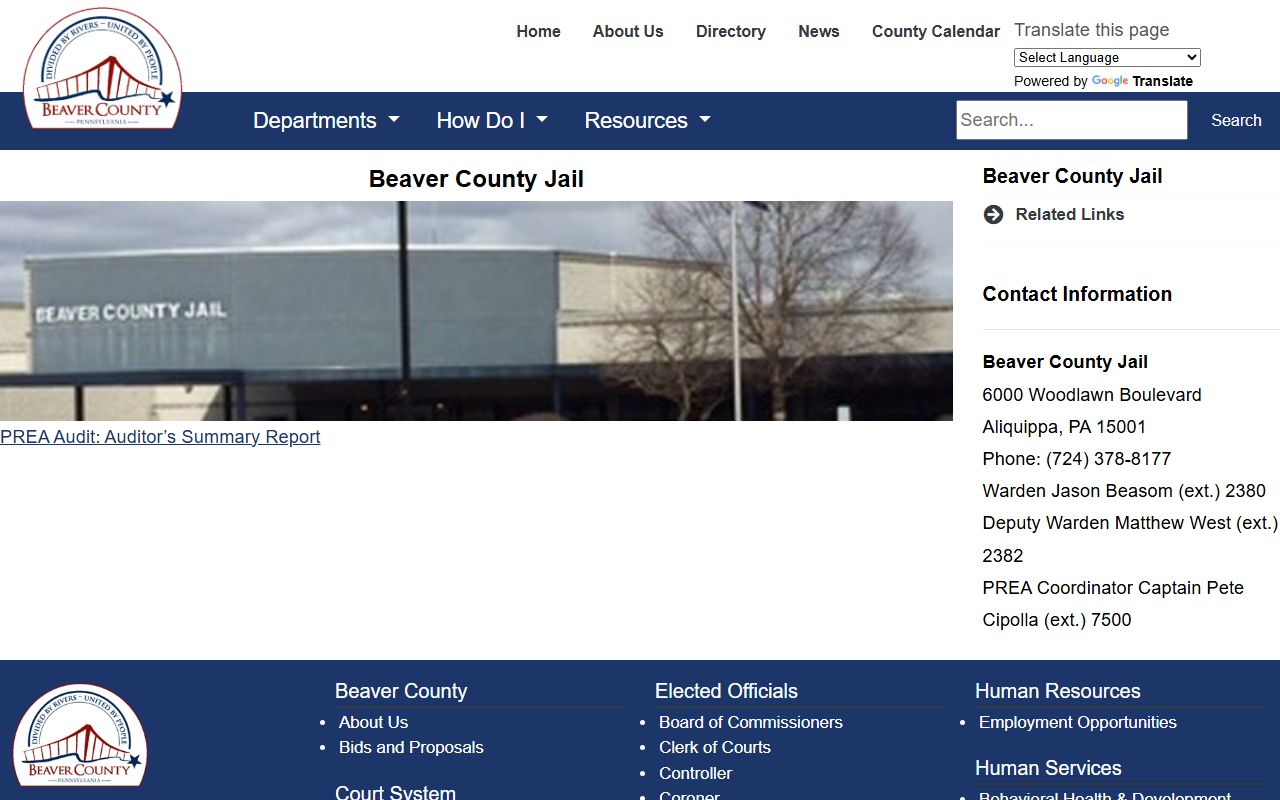
That distinction matters because a docket, booking entry, state inmate record, and custody notification are different records with different custodians.
Beaver County Court System
Beaver County is Pennsylvania's 36th Judicial District. The Court of Common Pleas is the county's general trial court, and it hears adult and juvenile prosecutions, civil disputes involving property or money, divorce, custody, child support, adoptions, trusts and estates, guardianships, administrative hearings, and appeals from Magisterial District Judges. The county court page identifies seven elected judges, with Hon. Richard Mancini serving as President Judge.
Lower-level cases begin in Magisterial District Courts. These courts handle traffic citations, non-traffic summary matters, landlord-tenant cases, small civil claims, preliminary arraignments, preliminary hearings, bail in many cases, and some warrant-generating failures to appear. Appeals from Common Pleas usually go to the Superior Court of Pennsylvania for ordinary criminal and civil matters or to Commonwealth Court for government and agency cases. The Supreme Court of Pennsylvania is the highest court.
Case flow: Magisterial District Court › Court of Common Pleas › Superior Court or Commonwealth Court › Supreme Court of Pennsylvania.
| Court or Office | Role in Beaver County | Common Record Types |
|---|---|---|
| Court of Common Pleas | General trial court for the 36th Judicial District | Criminal, civil, family, probate-related, juvenile, appeals |
| Magisterial District Courts | Lower courts for local and preliminary matters | Traffic, summary, landlord-tenant, small civil, preliminary criminal |
| Prothonotary | Civil filing and civil docket office | Civil suits, divorce, custody, liens, PFAs, appeals |
| Clerk of Courts | Criminal filing and financial office | Criminal files, bail, fines, costs, restitution, expungements |
Beaver County Court Record Types
Beaver County court records are split by subject and office. Civil Common Pleas records include complaints, writs, judgments, quiet title matters, condemnations, tax liens, municipal liens, custody orders, divorces, PFAs, arbitrations, District Justice appeals, appellate filings, and execution or possession writs. The Prothonotary is the main civil records office and is described by the county as the largest filing office in the courthouse.
Criminal Common Pleas records are kept by the Clerk of Courts. That office maintains criminal matters, files motions and petitions that affect criminal cases, processes bail bonds and expungements, collects fines and costs, distributes restitution, and archives criminal records. Magisterial District Court records cover local civil, criminal, landlord-tenant, traffic, and non-traffic cases. Probate, estate, marriage, adoption indexing, old wills, and Orphans' Court petitions are handled by the Register of Wills / Clerk of Orphans' Court.
- Civil records: Prothonotary records for claims, judgments, liens, custody, divorce, PFAs, and appeals.
- Criminal records: Clerk of Courts records for charges, pleas, bail, dispositions, sentences, fines, costs, and expungements.
- Traffic records: Magisterial District Court records and PAePay payment records for eligible citations.
- Probate records: wills, letters of administration, estate filings, and old Orphans' Court material.
- Custody and warrant records: jail, Sheriff, court docket, and statewide notification channels.
The official courthouse contact page confirms the main courthouse address, phone, and regular county hours. The courthouse remains the central place for many record questions even when a docket is visible online.
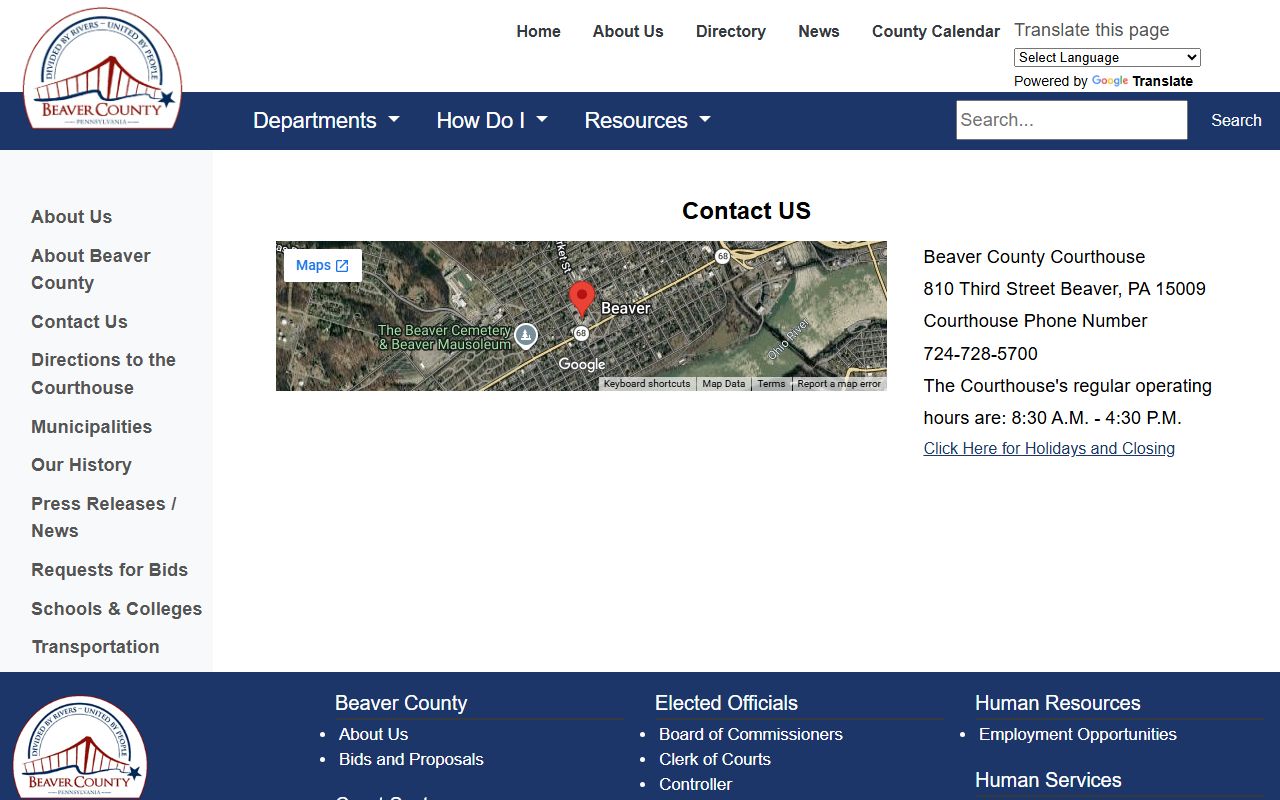
Use that county contact source when a record request needs an office address, main switchboard number, or courthouse hours before a visit.
What Beaver County Court Records Show
A Beaver County court record usually identifies the court level, county, judicial district, parties, docket number, filing date, case type, docket entries, and current case status. Criminal records may also show the OTN, SID, complaint or incident number, charges, plea, disposition, sentence, bail, fines, costs, restitution, payment plan details, and probation entries. Civil records may show plaintiffs, defendants, petitions, motions, orders, judgments, writs, liens, arbitration entries, and appeal activity.
Some fields are deliberately absent from public copies. Social Security numbers, financial account data, protected addresses, minor identifiers, sealed material, expunged information, adoption files, and most juvenile material should not appear in a public-facing record. A docket sheet is a public summary. It is not always the full file, and it should not be used as a substitute for a Pennsylvania State Police criminal history check.
| Field | What It Shows |
|---|---|
| Docket or case number | The court's tracking number; many MDJ cases begin with MJ. |
| Participant names | Defendant, plaintiff, petitioner, respondent, organization, or other listed party. |
| Filing or entry date | When the case or docket event was filed or recorded. |
| Case status | Whether the matter is open, closed, disposed, paid, transferred, or appealed. |
| Disposition | The result of a charge, claim, petition, or court event. |
| Financial entries | Fines, costs, restitution, service fees, payments, and balances where public. |
Beaver County Public Access Rules
Pennsylvania uses several layers of access rules. The Pennsylvania Right-to-Know Law governs Commonwealth and local agency records, while judicial records follow court-specific public access policies and Rule 509 for financial records. The UJS public records policies control public access forms, case records policy, statewide case data, and financial-record procedures.
For ordinary court case research, the practical order is simple. Search UJS first. Then contact the filing office that owns the complete file. Use the Prothonotary for civil files and divorce decrees, the Clerk of Courts for criminal files, the Register of Wills / Clerk of Orphans' Court for probate and marriage records, and the Court Records Manager for MDJ records that are not accessible through the web docket view.
Key Pennsylvania Rules:
18 Pa.C.S. 9122 governs expungement of qualifying criminal history record information.
18 Pa.C.S. 9122.1 covers petitions for limited access after qualifying conviction-free periods.
42 Pa.C.S. 6307 limits public inspection of juvenile court files.
42 Pa.C.S. 6308 restricts disclosure of juvenile law-enforcement records.
Restricted Beaver County Records
Not every Beaver County court record is public. Juvenile case files and juvenile law-enforcement records are restricted under Pennsylvania law. Sealed, expunged, and limited-access criminal records are not handled like ordinary public dockets. Adoption records are indexed by the Register of Wills / Clerk of Orphans' Court, but adoption court records are not normal public search records. Mental health proceedings may also be restricted because of the subject matter.
A person trying to clear a criminal record should identify the exact docket through UJS or the Clerk of Courts, then determine whether the matter fits expungement, Clean Slate or limited access, ARD completion, Probation Without Verdict completion, or another court-approved path. The Clerk of Courts processes expungements but does not act as a lawyer. Attorney access, party authorization, or a court order may be needed for restricted files.
Note: If public access is blocked, the lack of an online result does not prove that no case or record exists.
Beaver County Sheriff and Jail Records
The Beaver County Sheriff's Office, led by Sheriff Tony Guy, provides courthouse security, courtroom security, security checkpoints, civil writ service, PFA service, prisoner transport, juvenile transport, K9 units, and Emergency Services Unit support. The Sheriff is also responsible for Court of Common Pleas bench warrants, including failure-to-appear warrants in criminal cases, domestic relations warrants, and probation or parole violation warrants. No official online active-warrant list was located in the county sources reviewed.
The Sheriff's Office runs the Regional Booking Center at Beaver County Jail. The booking center handles intake, prisoner processing, video arraignments, and entry of data into state and federal databases. For custody status, Beaver County does not publish a verified county jail roster portal in the reviewed official sources. Use the jail phone line, Pennsylvania VINE for custody notifications, the PA DOC locator for state-sentenced inmates and parolees, and the PSP Megan's Law registry for sex-offender information. More detail belongs with Beaver County inmate records and Beaver County warrant records.
The Pennsylvania Megan's Law verification site results for Beaver County identify local verification points connected to sex-offender registry duties.
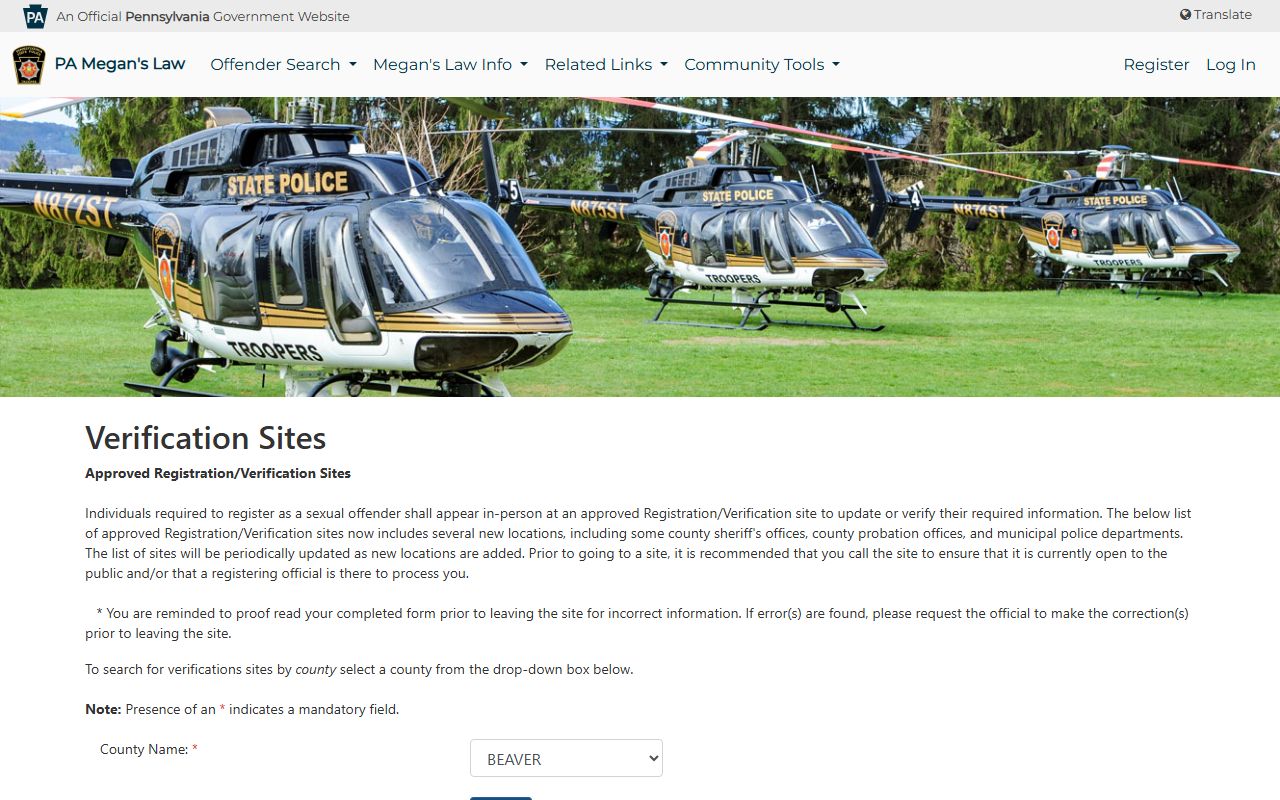
That registry channel is separate from court dockets, jail custody checks, and Sheriff bench-warrant responsibilities.
Beaver County Marriage and Probate
Marriage licenses, old marriage records, probate, wills, Orphans' Court petitions, and old estate records route to the Register of Wills / Clerk of Orphans' Court. Marriage license appointments are required, and a Pennsylvania license may be used only in Pennsylvania. Old marriage requests must include the requester's contact details, names, a date or five-year range, payment, email, daytime phone, and a self-addressed stamped envelope.
Divorce is different. Divorce decrees are civil records held by the Prothonotary. A certified divorce decree request by mail needs the parties' names, case number if known, a certified-copy request, payment, and a self-addressed stamped envelope. Older divorce searches may add a search fee. Probate requests for old wills and Orphans' Court records use the Register of Wills process, with records dating to 1800 for wills and 1804 through 1897 for old miscellaneous Orphans' Court material.
- Testacy
- The decedent left a will.
- Intestacy
- The decedent died without a will.
- Letters of Administration
- Authority issued by the Register of Wills when no will controls estate administration.
The Register of Wills page is the county source for marriage, probate, Orphans' Court, adoption indexing, and related records. It also points users to the Infocon county access portal for certain Register and Orphans' Court records.
That county source helps distinguish courthouse record offices from statewide court docket tools and private search systems.
Beaver County Record Fees
Fee rules depend on the office and record type. The research file identifies specific costs for divorce decrees, old marriage records, marriage license copies, old wills, and marriage licenses. It does not supply a single universal copy rate for every court file, so requests for case-file copies should be confirmed with the office that holds the file. PAePay adds its own service fee for online card payments.
| Item | Office | Amount or Method |
|---|---|---|
| Certified divorce decree by mail | Prothonotary | $6 check or money order payable to Jodi Jones, Prothonotary |
| Divorce search before 1995 | Prothonotary | $10 search fee, plus certified copy fee if needed |
| Marriage license | Register of Wills | $71 cash or credit card, no checks |
| Certified marriage license copy | Register of Wills | $5 |
| Old wills research | Register of Wills | $5 per name, maximum three names, then $1 per page for copies |
| PAePay card service fee | UJS / PAePay | Non-refundable 2.75 percent service fee |
Interpret Beaver County Dockets
Read a Beaver County docket from the top down. First check the court level, county, docket number, participants, filing date, and case type. Then look at docket entries in date order. A docket entry may mark a motion, petition, order, hearing, continuance, judgment, bail action, sentencing event, payment entry, or appeal. A disposition is the result of a case event or charge. A judgment is a final enforceable decision in a civil case.
Criminal terms need care. A charge is an accusation. A conviction follows a guilty plea, verdict, or other qualifying disposition. ARD is Accelerated Rehabilitative Disposition, and Beaver County Adult Probation notes that first-time offenders may complete supervision conditions and then seek expungement. Probation Without Verdict is a first-time drug-offense program with possible expungement after successful completion.
Beaver County Record Limits
UJS warns that recent entries made in court filing offices may not appear immediately. It also warns that docket data can be delayed, incomplete, or affected by errors or omissions. Magisterial District Court web docket sheets may disappear when the official paper record has been or should have been destroyed under the retention schedule. Online data is useful, but it is not always the final source for certified copies or legal reliance.
When details matter, confirm the record with the originating office. Use the Prothonotary for civil files and divorce decrees, the Clerk of Courts for criminal files, the Court Records Manager for non-online MDJ records, and the Register of Wills / Clerk of Orphans' Court for wills, estates, marriage licenses, and Orphans' Court material.
Note: Certified copies and official corrections must come from the office that maintains the original Beaver County record.
Beaver County Court History
Beaver County was formed from Washington and Allegheny Counties in 1800, and its court system began the same year when Pennsylvania created courts of justice for the county. A portion of northern Beaver County later became part of Lawrence County. The county homepage places Beaver County in southwestern Pennsylvania, bordering Lawrence, Butler, Allegheny, Washington, Ohio, and West Virginia, and uses the motto "Divided by its Rivers, United by its People."
The county courts page highlights more than two centuries of court history. It names Daniel Agnew, who later served as Chief Justice of the Pennsylvania Supreme Court for 15 years; James E. Rowley, a former President Judge of the Superior Court; and Ralph Scalera, who was appointed to the federal bench by President Richard M. Nixon. The modern court system still centers on the Beaver County Courthouse and the Court of Common Pleas.
The county about page provides local context and annual courthouse closure information that can affect in-person record requests. Holiday schedules should be checked before visiting a records office.
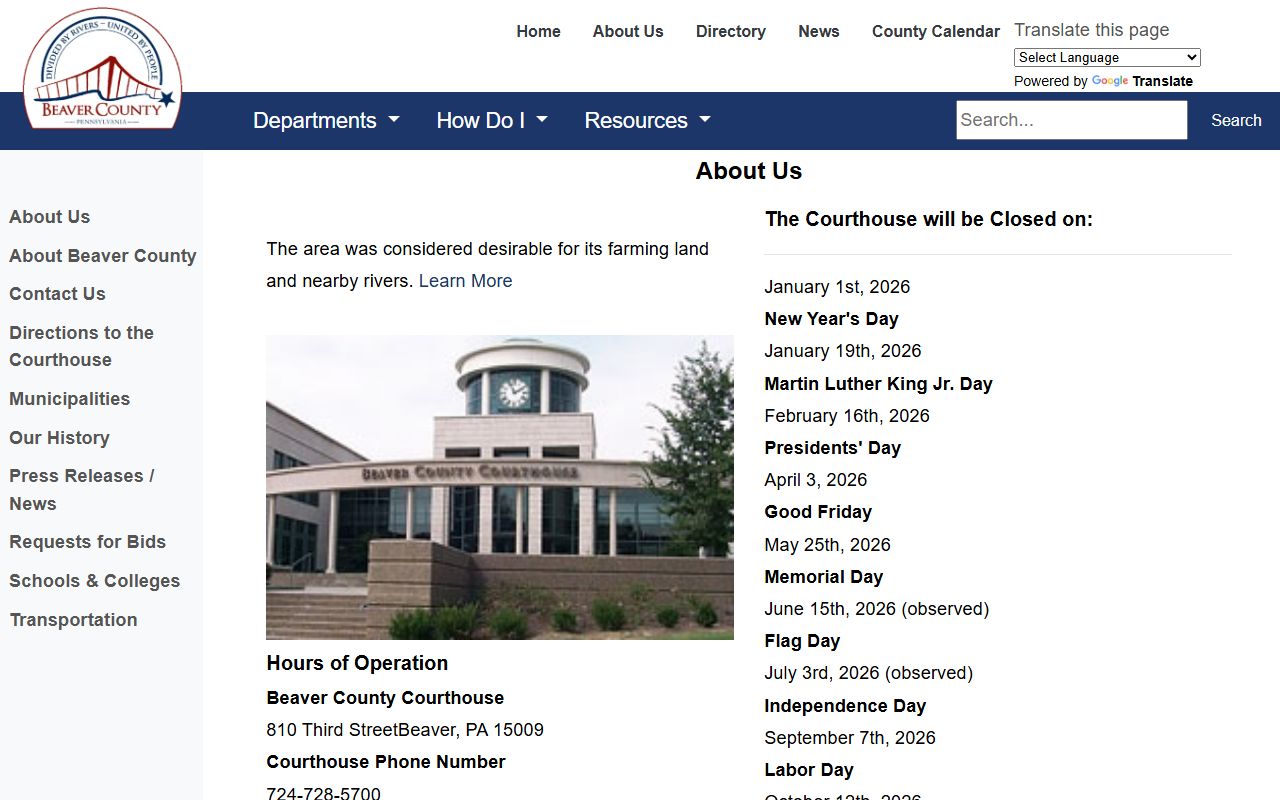
Historical and holiday details are not case records, but they help plan courthouse visits and explain how the county offices are organized.
Beaver County Court Records FAQ
Where should a Beaver County court records search start?
Start with UJS Case Search for public docket sheets. Then use the correct Beaver County office for copies or records that do not appear online. Civil files route to the Prothonotary, criminal files to the Clerk of Courts, MDJ records to the Court Records Manager or the issuing MDJ, and probate or marriage records to the Register of Wills / Clerk of Orphans' Court.
Are Beaver County criminal dockets the same as background checks?
No. UJS docket sheets can show public criminal case activity, but UJS says docket sheet information should not replace a Pennsylvania State Police criminal-history background check. A docket is a court record summary. A background check is a separate criminal-history product.
Is there a Beaver County jail roster online?
No official county jail roster search was located in the reviewed county sources. Custody questions should start with Beaver County Jail by phone. Pennsylvania VINE can provide custody notifications, and the PA DOC locator covers state-sentenced inmates and parolees, not ordinary county-facility inmates.
Who handles Beaver County bench warrants?
The Sheriff's Office handles Court of Common Pleas bench warrants, including criminal failure-to-appear warrants, domestic relations warrants, and probation or parole violation warrants. UJS dockets may show warrant-related entries, but they are not a complete warrant-verification system.
Where are Beaver County divorce decrees kept?
Divorce decrees are Prothonotary civil records. A certified copy request by mail needs party names, the case number if known, a request for a certified copy, payment, and a self-addressed stamped envelope. Older searches may require an added search fee.
Which office has Beaver County old wills?
The Register of Wills / Clerk of Orphans' Court handles old wills and old Orphans' Court records. The old-wills request process covers wills from 1800 to the present and old miscellaneous Orphans' Court records from 1804 through 1897.